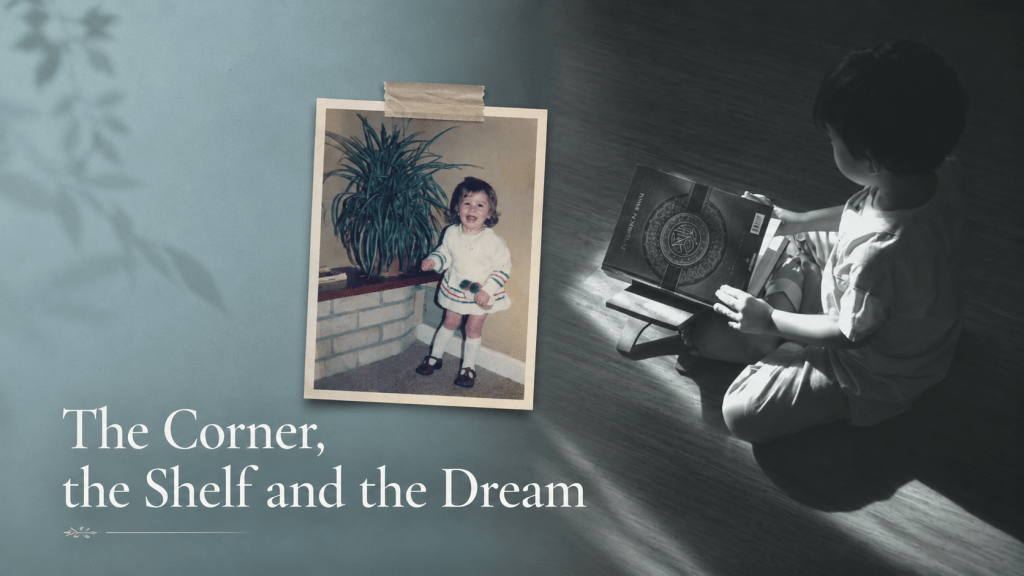
My mother educated herself about the world through books, with an appetite, a real appetite, devouring them, savouring them, caring for them. She read to me. There were radio programmes, plays and stories, some intended for me, others simply part of the atmosphere of the house, stories moving through rooms. Books were never decorative in our home. They were essential. Seeds, I understand now, that quietly shaped a life of meaning-making. The shelf was hers before it was mine. The wondering was hers too, I think.
In the living room of the bungalow I grew up in, she kept a low hearth ledge that ran along one wall: books about the land and country, history, stories of strong women, classics. A French phrase book that seeded a lifelong love of the language and, somewhere in its pages, a dream of elsewhere. A large illustrated volume on the countryside, almost too heavy to pull from the ledge, that fell open across my lap larger than life, its pages thick with nocturnal and woodland creatures, a hidden world rendered in such detail that every return yielded something new. And beside it, Richard Crossman’s Diaries of a Cabinet Minister, dense and dusty in its heavy gold-lettered volume, which held me too in its own way, puzzling over why one man would record his every ordinary day in such detail. I could not have known then how prophetic that question was. Arthur C. Clarke’s Mysterious World with its glowing crystal skull before Stonehenge at dusk. I can still see that cover perfectly in my mind’s eye, decades on. Some images lodge before you have the language to say why. And alongside the books, her collection of LPs, their inner sleeves carrying lyrics I would trace with my finger before I could properly read. A mismatch of worlds. Mystery beside domesticity. The inexplicable shelved next to the practical, as though that were perfectly natural.
Perhaps it was.
In the corner where the hearth ledge met the wall, there was an old-fashioned heating vent that blew warm air through a metal grid. Beside it stood a large spider plant that seemed to grow alongside me, making the corner feel sheltered, almost hidden. My parents worried about what I was breathing, sitting so close to the vent, and would usher me away. But I kept returning. It was cosy there. Receiving. The particular feeling I have sought, I think, in libraries ever since: of being held inside something larger than yourself, safe within an abundance you could not fully see the edges of.
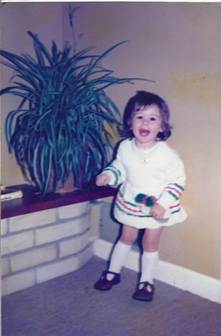
This photograph was taken before I was two. The corner had claimed me before I could read.
By five I was already starting to read, and I would come in after a bath, or in the early quiet before the house woke, or while my mother was in the kitchen, the radio on somewhere, cushion or blanket in tow, warm air at my back, tucked in beneath the green, and pull a book free just to look at it. Not necessarily to read. To feel the presence of it. To trace the index, the names, the colours. I did not have the language then, but I think I was already responding to the traces of another life. Evidence that someone had spent years noticing, wondering, wrestling with something long enough to gather their thoughts between covers and leave them waiting for a stranger. But even then, I never sensed a book as an inanimate object. It was a conduit. A communion. Someone’s existence, made available.
I don’t know where this came from. But it was in that corner, I think, that certain goals formed, without fanfare. That I would go to university. That I would write at least one book of my own, my own sense of things, mapped and curated, captured and bound, and leave it on a shelf for someone else to find. I had no idea it would take the best part of a lifetime. I had no idea I didn’t even know I was a phenomenologist before I was one.
I hadn’t anticipated the searching.
Recently, visiting a university library, I found myself walking the first line of shelves before I quite knew what I was doing, eyes trailing spines, asking something I hadn’t expected to ask. Where have they placed me? Who, what, am I, in here? There is something quietly vertiginous about that moment, scanning a library’s logic for your own name, waiting to discover how the world has classified you, where the institution has decided you belong. A small judgment. A placing. And you either fit the neighbourhood or you don’t.
And then there they were. Or rather, there one of them was.
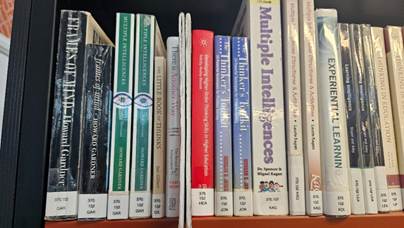
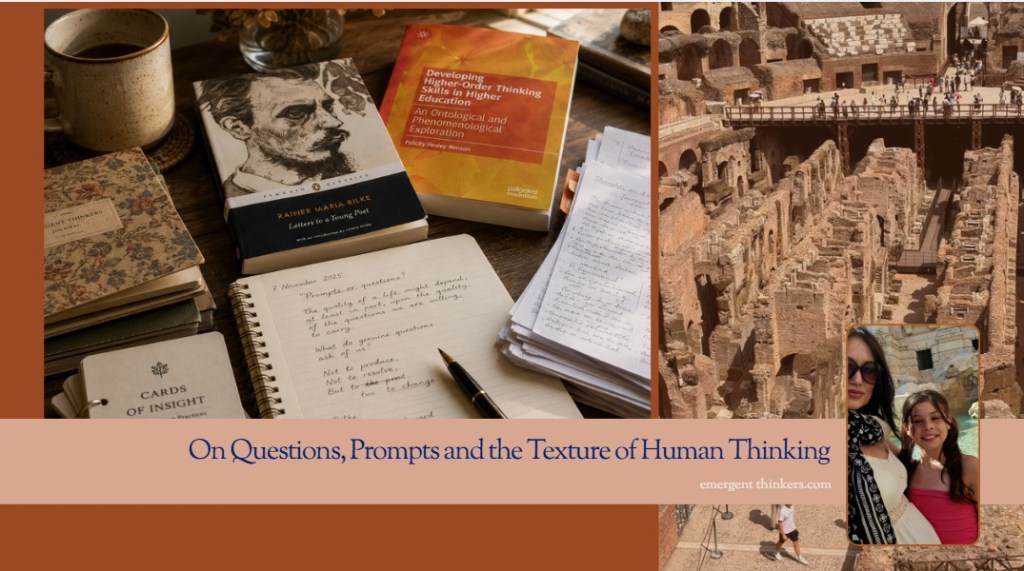
My newer work, Developing Higher-Order Thinking Skills in Higher Education: An Ontological and Phenomenological Exploration, published this January, shelved at 370.152, educational psychology, thinking, cognition, between Howard Gardner’s Frames of Mind to my left, dark and cracked with decades of handling, and The Thinker’s Toolkit to my right. I smiled to myself, indulging briefly in my own J. R. Hartley moment, courtesy of 1980s advertising.
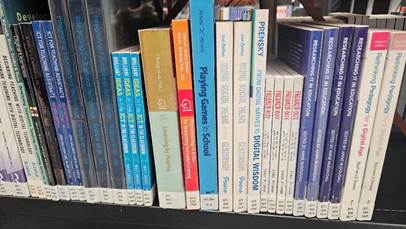
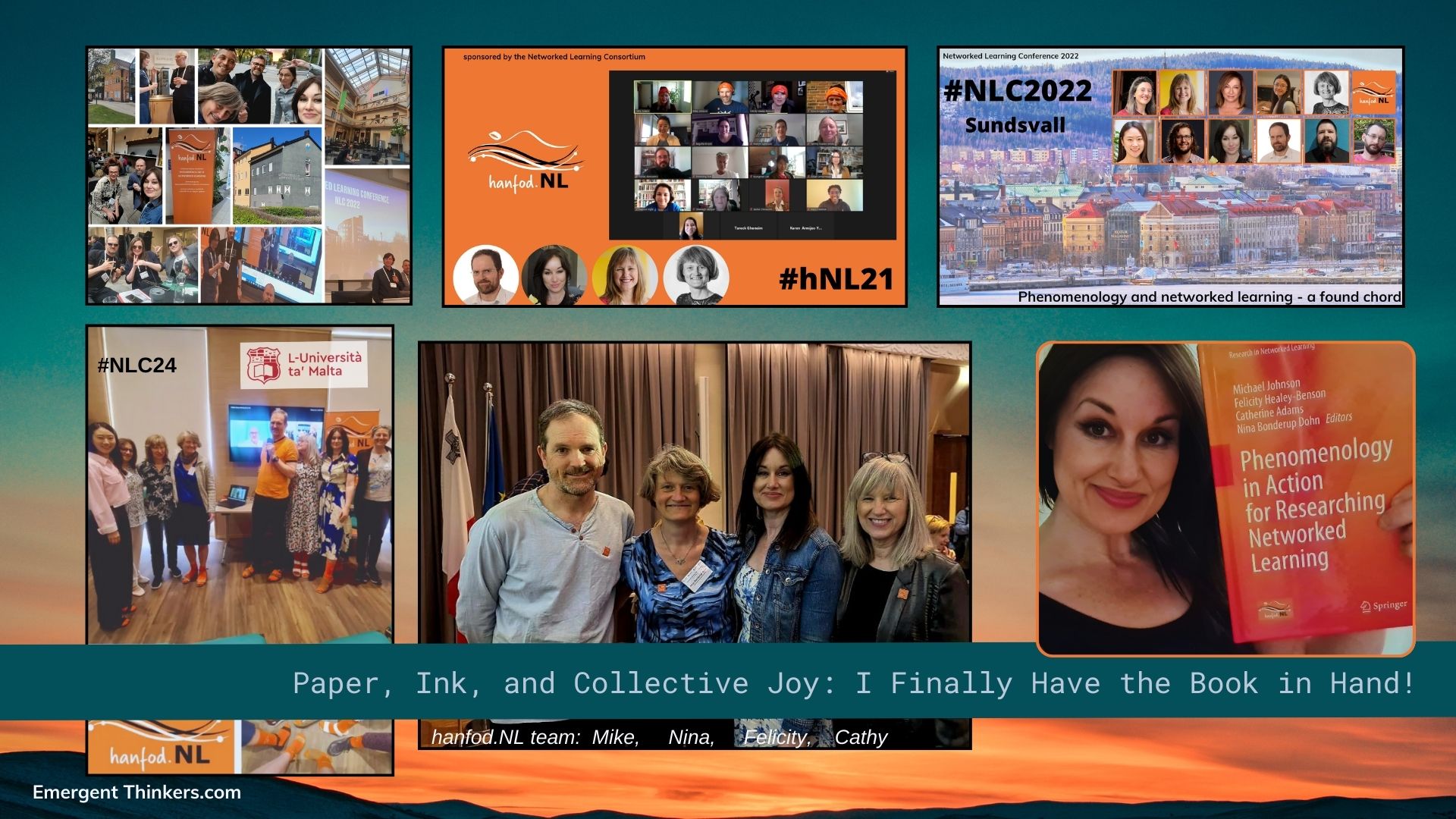
The edited collection I co-authored, Phenomenology in Action for Researching Networked Learning, I found in a different section entirely. Educational technology, digital learning, among Prensky, ICT in the Classroom, Rethinking Pedagogy for a Digital Age. I had spent years trying to hold these worlds together. The library, with characteristic confidence, had quietly separated them. A different conversation. A different intellectual neighbourhood. I was surprised, if I am honest, to find myself split. My work has always moved between territories, perhaps more than most, but I had not expected the library to confirm it quite so plainly, quite so institutionally. The same building. Both mine. Both readings defensible. Both partial. Neither shelf alone holding all of what I am. A moment of pride, then. Complicated, as pride sometimes is, by something harder to name.
And then I noticed where I was.
Not a weighted, worn, atmospheric place. Not the library I had known as a student, darkened by density, humbled by volume, the kind of place you could lose an afternoon in and emerge changed. This was a relatively sparse new build. Clean. Functional. Around me, heads bent behind large screens, or angled down at phones. No one wandering. No one sitting cross-legged on the floor with an accidental pile growing beside them. The shelves themselves felt over-neat, composed, almost staged, unlived in the way a room feels unlived when no one has ever quite settled into it.
I pulled one of my own books free, turned it in my hands. No issue slip tucked inside the cover. No fading stamp. No crossed-out borrowing card carrying its quiet archive of encounters, someone in October, someone desperate near exam season, someone perhaps lost in the same questions I had once been lost in myself. Nothing to betray its utility. Nothing to disclose whether it had been needed, carried, wrestled with, or barely touched. The history was there, somewhere, buried in invisible systems, in databases and borrowing metrics, in data no one would ever feel through their fingertips.
The dream had arrived. Yet the world the dream belonged to felt, in that moment, already partly passed. I stood there holding two feelings I could not quite separate. Elated. And quietly bereft. Maybe I am simply getting old. Maybe this is nostalgia dressed up as something more considered. I don’t entirely dismiss that.
But I think it is something more precise than nostalgia.
The libraries I knew as a student, and long before that as a girl of eleven, offered something I have not found a digital equivalent for. Every Saturday, my best friend Amanda and I would walk the forty-five minute route down from the hills into town, heading always for the library. We would spend at least an hour returning books and gathering new ones, scanning spines, indexes and pictures, taking a punt on whether a dense older volume might yield a single useful line, or surprise us entirely.
What we carried home was never certain. The potluck was part of it. You took the book on faith, on instinct, on something that caught your eye without quite knowing why. And you carried it physically, in heavy bags up hills on warm afternoons, my father scolding me for the weight on my shoulder as I continued up the valley hill instead of calling home for a lift. I still have a dropped shoulder from those years of carrying books. I think, sometimes, that those years left their own kind of trace on me, the library written into the body.
Those older libraries felt sedimentary. Layer upon layer of thought accumulated physically around you. Different floors carried different intellectual moods. Journals. Reference sections. Basement stacks. Half-forgotten specialist collections. You moved through atmospheres as much as buildings. The library did not flatter your certainty. It humbled it. There were always shelves you had not yet reached, authors you had never heard of, entire territories of thought existing beyond the edge of your question.
So much meaningful thinking begins before articulation. Before keywords. Before certainty. Sometimes understanding starts as atmosphere, as disturbance, as vague attraction, a book lifted from a shelf almost without conscious reason. The stacks allowed space for this drifting. They permitted thought to emerge slowly, relationally, often through surprise. You went looking for one thing and emerged carrying another. A title glimpsed sideways. A sentence encountered unexpectedly. A thinker you did not know you needed until you found them by accident.
Search engines are extraordinarily powerful, but they require intentionality. You must already know enough to ask. The shelves sometimes revealed what you lacked the language to seek.
The old library, at its best, offered what that corner once gave me as a child. The feeling of being held inside something larger than yourself. Of being surrounded by more than you could ever fully master. Of productive bewilderment, the particular quality of not-yet-knowing that precedes genuine thinking rather than mere retrieval.
What I sensed in that sparse new build was the thinning of precisely that. Not the absence of books. The absence of density. Of weight. Of the accumulated physical presence of thought pressing in from every side, waiting to be accidentally found. My own books did not appear nestled within an overflowing ecology of neighbouring texts. They floated there, visible, in a quieter, leaner harbour than decades of dreaming had placed them in.
Not held. Displayed.
And the books themselves, handled without trace, carried without residue, borrowed and returned invisibly, felt somehow less inhabited. Less needed. Less alive in the particular way that use discloses life. Older library books bore evidence of passage: softened spines, pencilled hesitations beside difficult passages, old receipts or train tickets left between pages, corners turned by urgency or fatigue. The object testified to duration. Not merely knowledge stored, but knowledge lived with.
Their wear was not deterioration. It was proof of intellectual life.
I confess I cannot pass a book left open face-down, its back strained by carelessness, without wanting to rescue it. There is a difference between a book softened through love and one harmed through neglect. The worn spine I honour. The splayed one I cannot leave.
And then, around the same time, among the messages beginning to arrive, one from Auckland University of Technology: they had ordered the book for their own library. On the other side of the world, an institution had independently decided it wanted these ideas on its shelves, made its own judgment about where they belonged, chosen its own intellectual world for them, a world I would never see, beside thinkers I might never know were now my neighbours.
The dream, it turns out, had a much wider geography than one shelf in one sparse new build.
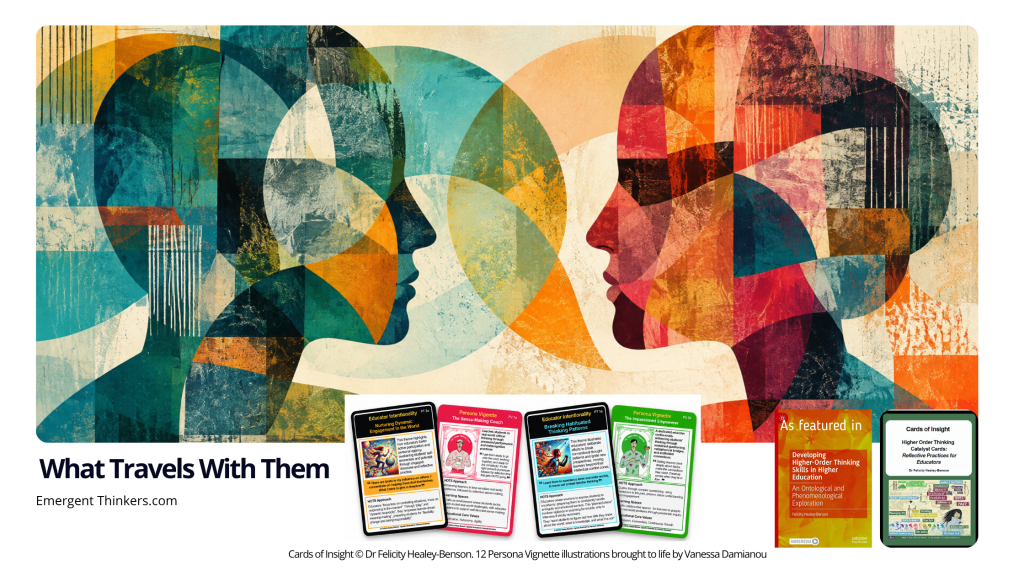
I had chosen to dress it in red for a reason. To speak of passion. Of humanness. Of something warm beneath the argument. The Networked Learning collection had arrived in orange, serendipitously hanfod.NL orange, already part of my DNA, as though the series had read me before I had read myself. Serendipity wearing the colours of belonging. Both books warm. Both alive. Both now out of my hands entirely, travelling into conversations I will never witness, being pulled free by hands I will never know, entering lives I cannot imagine.
Which is, I think, what a book is for.
I find myself hoping they lose their newness slowly and well. That they travel in someone’s bag. Sit beside coffee stains and hurried notes. Get underlined in the wrong places by someone who found the right thing anyway. Returned late. Carried between uncertainty and discovery, the way I once carried borrowed books home as a girl, heavy and hopeful, not entirely sure what I was looking for.
Softened at the corners. Not pristine. Not displayed. Inhabited.
Because that is what the child in the corner always understood, before she had the language for it, that a book is not an inanimate object. It is a conduit. A communion. Someone’s existence, made available. And if you are very lucky, and you work for a very long time, and you sit long enough in enough corners with enough warm air at your back and enough wonder at what other lives have left behind,
perhaps one day you leave a little of your own existence there too. For someone else to find.
Felicity.
Blog image, backgrounded child, image by Amirul Muiz; photograph author’s own.





Leave a Reply