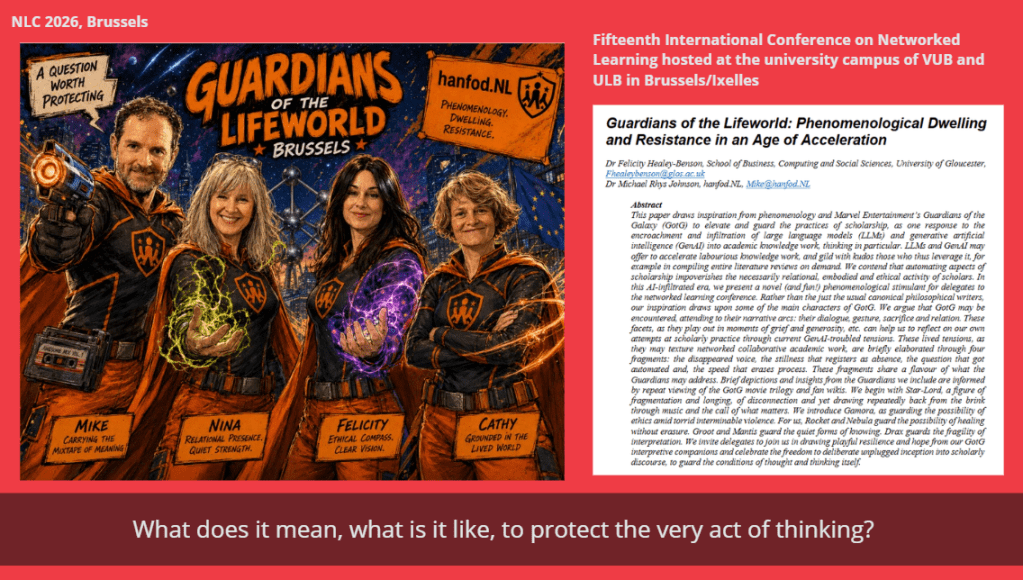
There is a tradition now, at the Networked Learning Conference, that we, hanfod.NL bring phenomenology swathed in orange.
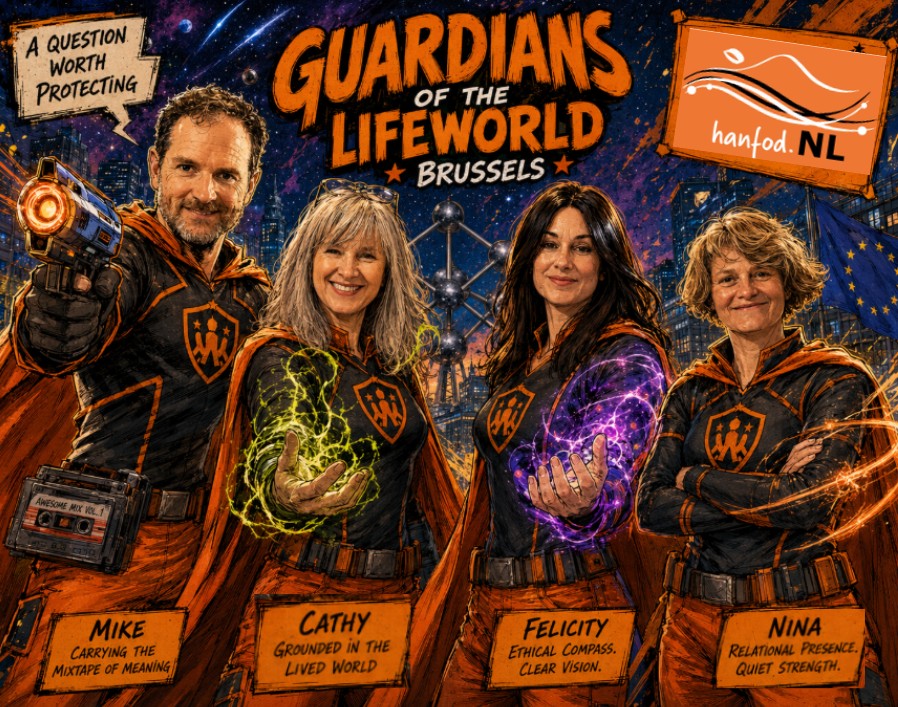
It started with our hNL21 node event in 2021, a workshop that planted a seed. Then the orange beanies and badges in NLC Sundsvall 2022, celebrating our double symposium and the collaborators who made it possible. In NLC Malta 2024, orange socks, marking the pre-launch of our Springer edited collection at the Valletta reception with Professors Cathy Adams and Nina Bonderup Dohn, the hanfod.NL four together. This year, NLC Brussels 2026, figurative orange superpants, we did bring superpowers to the table, as homage to the Guardian spirit.
Because if you are going to argue that phenomenology can guard the very conditions of thought in an age of acceleration, you might as well metaphorically dress for the occasion.
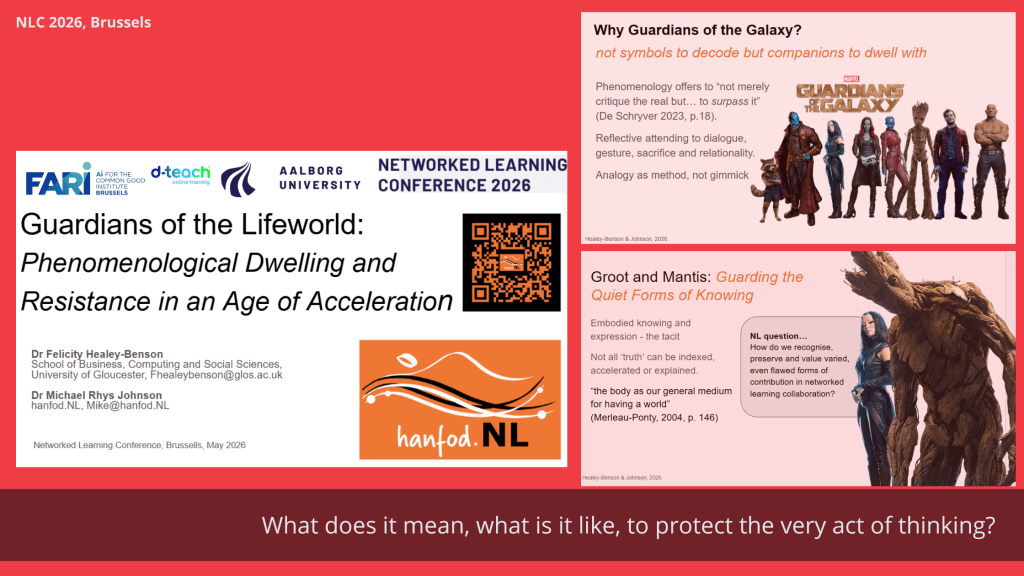
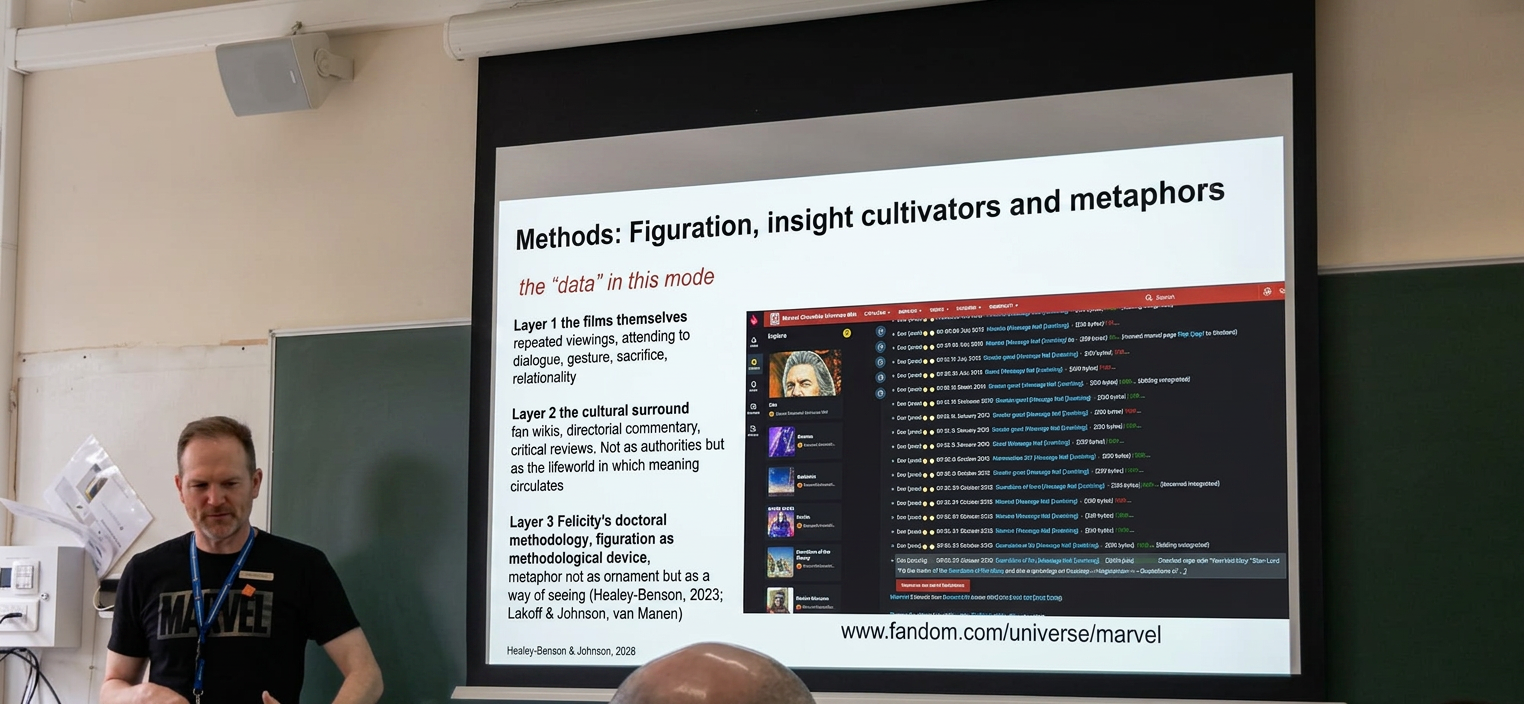
So, our paper, Guardians of the Lifeworld: Phenomenological Dwelling and Resistance in an Age of Acceleration, landed at the Fifteenth International Conference on Networked Learning hosted at the university campus of VUB and ULB in Brussels/Ixelles, Mike bravely tackling the room. Ideas that grew from our Springer edited collection, from the generative spark that Cathy and Nina helped light in our hanfod.NL meeting in March 2025, and from a restlessness none of us could quite shake.
The question at the heart of it is this. In an era where large language models accelerate, automate, and optimise, what does it mean to protect the very act of human thinking? Not thinking as information processing or efficient output. Thinking as a mode of dwelling.
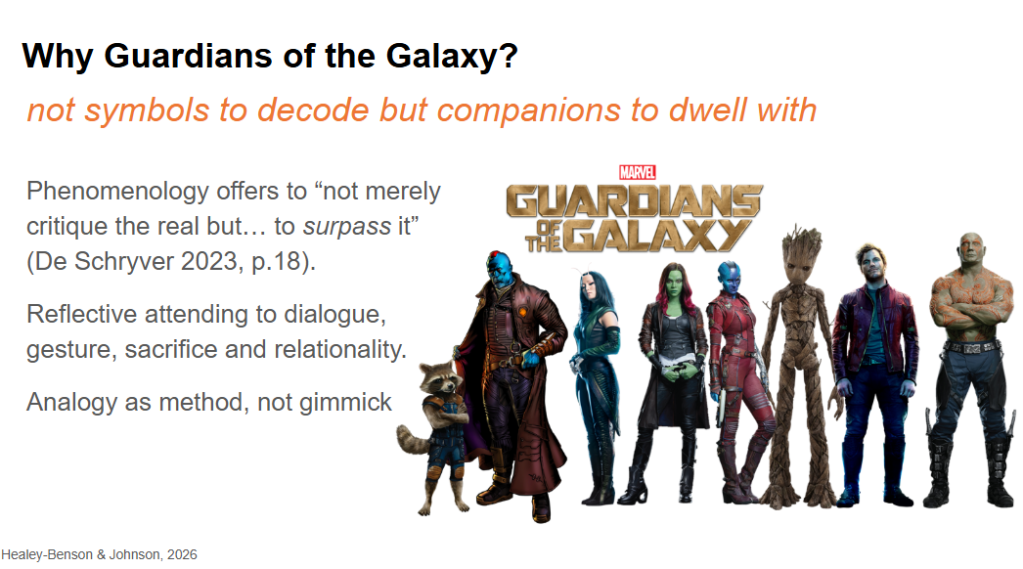
We found our unlikely companions in the Guardians of the Galaxy. Not as symbols to decode, but as companions to dwell with. Star-Lord carrying his mother’s mixtape as a sonic reliquary through worlds he did not choose. Gamora refusing to surrender her ethical bearings even when loyalty threatens to undo her. Rocket and Nebula, bodies mapped by intrusive intervention, guarding the possibility of healing without erasure. Groot and Mantis, quiet, relational, pathically present, guarding the forms of knowing that cannot be indexed or explained or accelerated. Drax, whose literalism reminds us that the refusal to play with meaning is sometimes the tell of having once been severed from it. We named what we are seeing as humanity sidelined. Fragments of post-digital scholarly practice where the machine prevents humans from humanly benefiting. Not error. Not hallucination. Estrangement from one’s own voice.
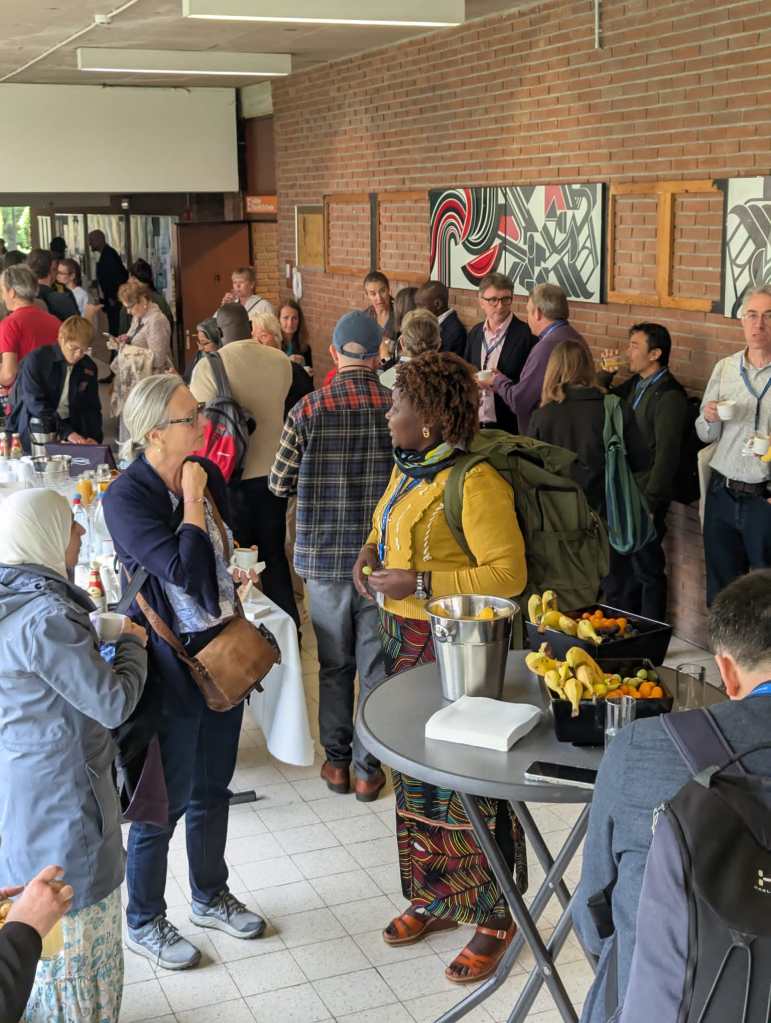
Mike commented phenomenology is triggering something at the conference right now. People feel drawn toward it but some can’t quite go there. And when you hold it up to the light, something stirs. Recognition. Discomfort. Often both at once. That gap between feeling the truth of something and not yet having language for it, that is exactly the territory phenomenology inhabits. And it may be that people are ready for it in ways they haven’t quite been before.
What our Guardians offer is not perfection but persistence. Not mastery but memory. Not solutions but responsiveness. A commitment to ponder with what resists capture. A way of thinking that lingers when all else has moved on. To guard thinking is not to own it or package it. It is to accompany it. To shelter it. To believe that something human remains worth protecting even when it becomes inconvenient to systems of speed. True heroism, as the Guardians remind us, is response not power.
I have been thinking about why this question will not leave me alone.
My doctoral work was built around a single, stubborn fascination. What actually happens when genuine thinking begins to stir in another person? For years I pursued that question phenomenologically, drawn into what I can only describe as the hard-to-express spaces of an ineffable phenomenon. I stripped away the conceptual to expose the taken-for-granted. I glimpsed, I believe, something of the mystery. And I found I could barely describe what I had seen in simple terms. I think that difficulty was the point. The world is bewildering, enigmatic, and worthy of our fuller attention. And right now, something is quietly filling the space where that attention should be, before it can fully form. Where the grappling gets bypassed. Where the mess, which is where the thinking actually happens, gets smoothed into something fluent and finished before anyone has had to be changed by the process. That is not an abstract concern for me. It is the question. And it is why this paper, and the wider conversation it opens, feels urgent in ways that go well beyond academic interest.
The paper is live. The conversation continues.
https://journals.aau.dk/index.php/nlc/issue/view/NLC2026
https://journals.aau.dk/index.php/nlc/article/view/10957/8928
Warm thanks to the NL Consortium and organising team, and this year’s hosts, FARI – AI for the Common Good Institute and d-teach – Online School and Training Centre.


Linked posts
https://emergentthinkers.com/?s=phenomenology
hanfod.NL is scholarly society which promotes and explores the application of phenomenology within educational technology practice and research.



Leave a Reply