
4th June. One year ago today, I last held my father’s hand. That moment birthed an all-consuming grief that transported me into a dual reality: One, where life continues as normally as can be manufactured, for the sake of a young family, and Another, where I exist in a grief state, bruised from being flung into the front line of mortality.
And from this pain, emerged something unexpected – an amplified ‘inner voice’ and an overwhelming urge to write.
The Power of Voice and Lived Experience
I come from a family of storytellers, where rich oral histories flow through songs, stories, and comfortable, merry conversation. My father’s voice carried within it two inseparable parts of his identity: his warm Irish accent and the hard-earned wisdom of his educational journey. That voice, different from mine, didn’t just embody our family’s heritage – it carried the echoes of classroom doors closed against opportunity, of determination forged in disadvantage, and of triumph over circumstances that might have silenced a less resilient spirit.
His stories, told in that distinctive accent, often returned to his brutal experiences in 1940s and ’50s Ireland’s educational system. The memory of those closed doors and limited opportunities never left him, but neither did they embitter him. Instead, they fueled a fierce determination to ensure his children would have the educational opportunities he was denied. Even as his accent marked him as an outsider in some circles, he used that same voice to advocate for his family’s future, to share wisdom, and to pass down our heritage through stories told around countless dinner tables.
Academic Journey and Living Legacy
This interweaving of voice and educational experience has gained new meaning as I prepare to present at the ICDE’s 28th World Conference on Online Learning in Ireland this November. The conference’s location in my ancestral home, the land of my father, stirs deep emotions. I am excited about the academic and professional experience, but I grieve that I will not share this moment with Dad. He would have seen it as more than just a professional achievement – it would have represented the fulfillment of his lifelong dream, proof that his struggle to reimagine education’s role in our family had borne fruit in ways he could never have imagined in his own schooldays.
Stories That Shape Us
Every researcher brings their own narrative to their work, whether acknowledged or not. At the beginning of my doctoral journey, I was encouraged to examine my foundational beliefs, to understand the significance of subscribing to certain social or personal values which could potentially undermine my rationality (Howarth et al., 2016). This self-reflection has led me to recognise how my father’s experiences have shaped my own approach to education and research.
“Ancestral memory and nuance break on the shores of thought” (O’ Donohue, 2000)
His story has also taught me to question how accent and educational background influence how individuals are perceived and treated (Khilay, 2016). I consider now how these factors might impact my own interpretive framework within qualitative research, and how meaning-making is always located within specific social environments, times, and places – just as my father’s educational experience was shaped by the Ireland of his youth.
The Thread of Memory and Purpose
In my current reality, these reflections take on added weight as I face my own challenges with voice. An upcoming throat surgery risks vocal cord paralysis, threatening a temporary yet unpredictable period of voicelessness. This potential loss has deepened my appreciation for voice not just as a tool for communication, but as a carrier of history, identity, and transformation – just as my father’s voice carried both his accent and his aspirations for future generations.
Through all of this, I’ve discovered that storytelling has a legitimate place in academic writing and research. As EDIT99 (2018) notes, “Manuscripts submitted for publication, dissertations, and other research reports tell the story of a scientific investigation”. As a researcher, I must be mindful of the discretionary power (Tiselius, 2018) bestowed upon me as the conduit through which stories will be told, just as my father’s story has been entrusted to me.
Finding Peace in Purpose
Twelve months after my father’s passing, I’ve found some solace in recognizing how he equipped me with both the confidence to face new challenges and the understanding that education can be transformative. His lived experience – from the harsh classrooms of his youth to his triumph in creating educational opportunities for his children – has become an integral part of my own academic journey. While there are no benefits from loss, the process of reflecting and retelling our shared life story has revealed lasting gifts. As Campbell (2013) reminds us, “You never know who it could affect, how, or to what it could one day lead.”
This November, I won’t physically meet my father, Jim Healey, on the banks of the River Liffey with his Guinness in hand. But I will stand there, proud, carrying within me both his voice and his vision – that beloved voice that told stories of struggle and triumph, and that unwavering commitment for a true education to transform lives.
Through my research and writing, I hope to honour both his memory and the complex legacy he handed down – the power to share ideas, change perspectives, and open doors that were once closed to him.
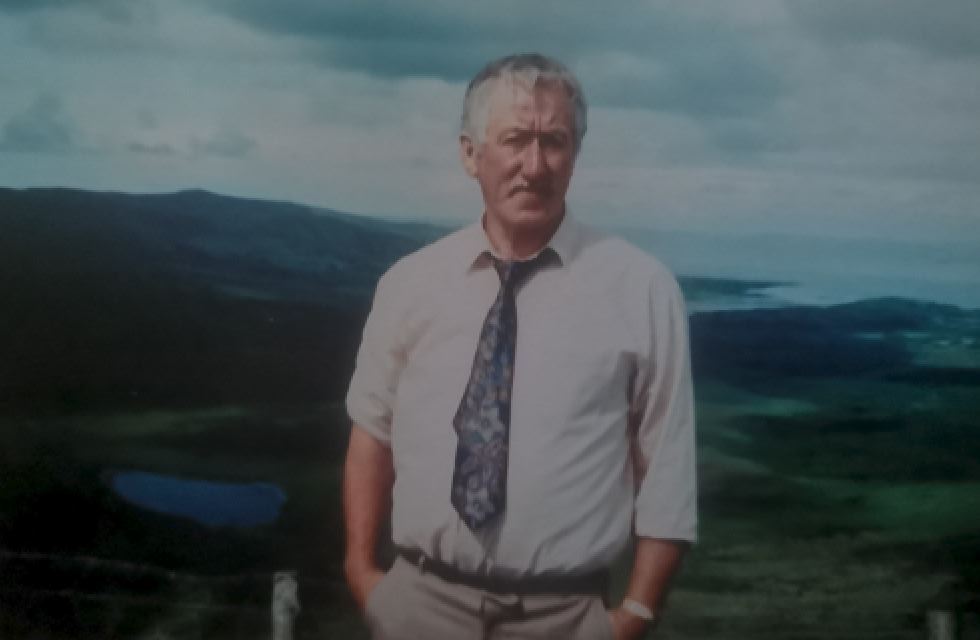
‘Absence is full of tender presence, and nothing is ever lost or forgotten’ (O’ Donohue, 2000) when held in someone’s story.
References
Campbell, S. (2013) ‘The importance of finding your voice in a 2019 world’ [online]. Available: https://theascent.pub/the-importance-of-finding-your-voice-in-a-2019-world-8856200735e2 [Accessed 1st June 2019]
EDIT911 (2018) ‘The Art of Storytelling’ [online]. Available: https://edit911.com/the-art-of-storytelling-in-academic-writing-5-steps-to-a-better-research-paper/ [Accessed 1st June 2019]
Khilay, S. (2016) Speaking my language: how accent impacts our opinion of others [online]. Available at: https://www.personneltoday.com/hr/speaking-my-language-how-accent-impacts-our-opinion-of-others/ [Accessed 1st June 2019].
Laslett, B. (1999) ‘Personal narratives as sociology’, Contemporary Sociology, 28(4), pp. 391-401.
Mehra, B. (2002) ‘Bias in Qualitative Research: Voices from an Online Classroom’, The Qualitative Report, 7(1), pp. 1-19. Available at: http://nsuworks.nova.edu/tqr/vol7/iss1/2 [Accessed 2nd June 2019].
O’Donohue, J. (2000) ‘Eternal Echoes: Exploring Our Hunger To Belong’, Bantam Press: Great Britain
Shulman, L.M. (2018) ‘Before and After Loss: A Neurologist’s Perspective on Loss, Grief, and Our Brain’, Johns Hopkins University Press.
Tiselius, E. (2018) ‘The (un-) ethical interpreting researcher: ethics, voice and discretionary power in interpreting research, Perspectives, DOI: 10.1080/0907676X.2018.1544263




Leave a Reply