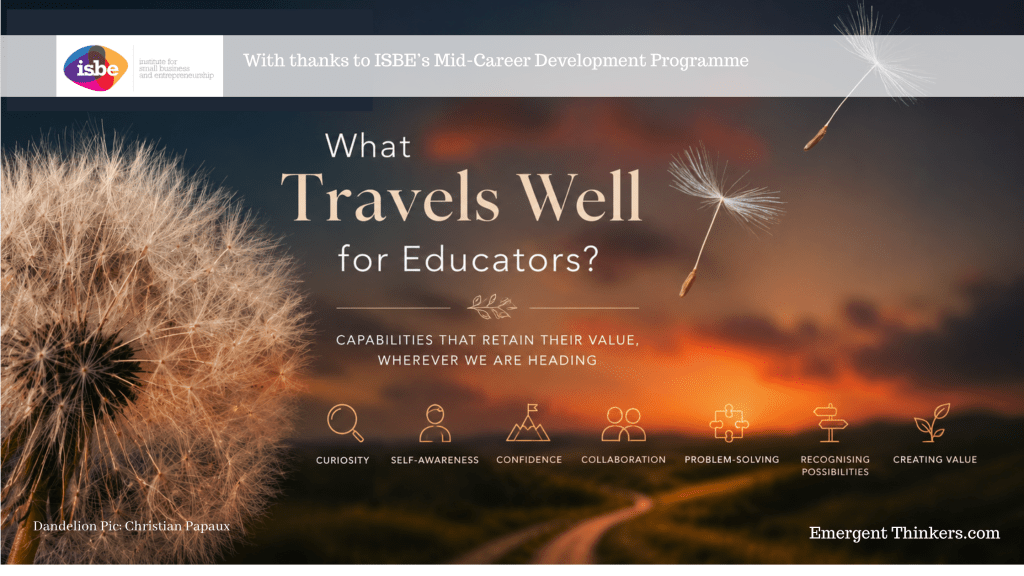
Earlier this year, talking with young people about careers and uncertain futures, I found myself using a phrase that has stayed with me: develop capabilities that travel well. In this I mean the things that retain their value even when we don’t yet know exactly where we’re heading: curiosity, self-awareness, confidence, collaboration, problem-solving, recognising possibilities and the ability to create value from the experiences and resources already around us.
Some of the young people were worried that not knowing exactly what they wanted to do at 15, 16, meant they were already behind. It seemed an important message to offer them: uncertainty now does not necessarily mean limitation later. As it turned out, I was about to have a rich opportunity to turn the question around on myself and consider what travels well for educators?
Last month I completed the first ISBE Mid-Career Development Programme, following six months of workshops, mentoring, Action Learning Sets, conversations and, perhaps most importantly, some deliberately protected space to think.
Most of my career has been spent developing other people, in one form or another: organisational learning and development, higher and professional education, enterprise educator development, and more recently, research into how educators actually experience thinking and reflection. Being deliberately back on the receiving end of professional development myself felt oddly exposing.
One thought has stuck: development isn’t always about adding more.
Of course, I learnt new things, encountered different expertise and came away with ideas to take further. But some of the most useful moments were harder to locate on a programme schedule. A mentor asking a question I could not immediately answer. Someone in an Action Learning Set looking at something I’d become accustomed to and seeing it differently. A conversation connecting pieces of work I’d previously held apart. Or simply having enough space for an unfinished thought to remain unfinished for a little longer.
A very genuine thank you to Dr Emily Beaumont and Professor Robert Newbery, who led the pilot programme; to Dr Kelly Smith, Professor Paul Jones, Professor Susan Marlow, Professor Eleanor Shaw, Professor Stephen Roper and Professor Gideon Maas, who brought very different expertise and perspectives to our workshops; and to the mentors, Action Learning Set colleagues and fellow participants who made the experience considerably richer. It reminded me that people participating in professional development are not simply its recipients. Under the right conditions, we become part of the developmental resource for one another.
Developing the people who develop other people
We ask a great deal of educators: to respond to changing technologies and learner expectations, work across disciplinary boundaries, connect learning with worlds beyond the classroom, and make increasingly thoughtful decisions about where AI belongs. Within enterprise education there’s another layer again. We ask educators to help learners recognise possibilities, create value, collaborate and act when the answer isn’t entirely known.
Sometimes the interesting work happens between things
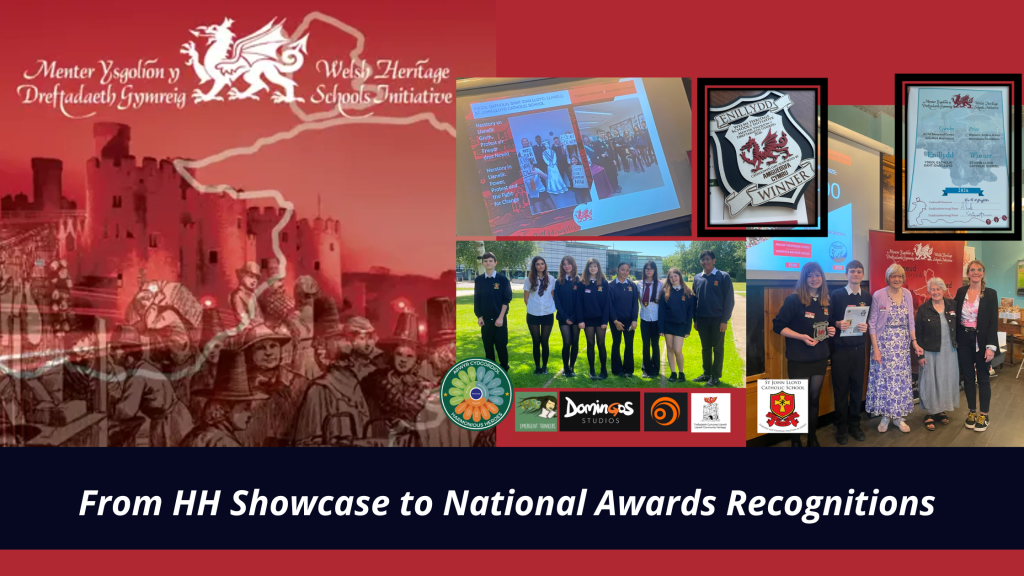
Harmonious Heroes brought this home to me. It began with a persistent question: what might enterprise education become if it was values-led, locally rooted and able to work with the reality of school life rather than adding another layer of complexity? The resulting projects have brought together schools, learners, businesses, creative practitioners and community partners around real local challenges [Real projects, real skills, real futures].
What continues to interest me is not simply what each participant brings, but what happens between them. A piece of curriculum meets a community story. A teacher meets a practitioner with expertise they did not know was nearby. A business encounters children asking questions it had not expected. A learner’s idea moves beyond the classroom because somebody else sees possibility in it. None of those ingredients necessarily has to be new. Sometimes the innovation is in the connection.
That feels like something that travels well: the ability to notice what and who is already around us, cross a boundary, make a connection and create the conditions in which something different becomes possible.
Frameworks don’t walk into classrooms by themselves
We certainly aren’t short of frameworks, models, research or policy telling educators what they might consider doing. I value many of them and have spent considerable time working with EntreComp and EntreCompEdu, helping educators explore entrepreneurial competences within their own disciplines and settings. But knowing the framework is rarely the end of the work, but rather, With these learners, in this subject, within this context and with the resources and possibilities we actually have? This requires more than transmission. It requires translation, and I think that travels well too.
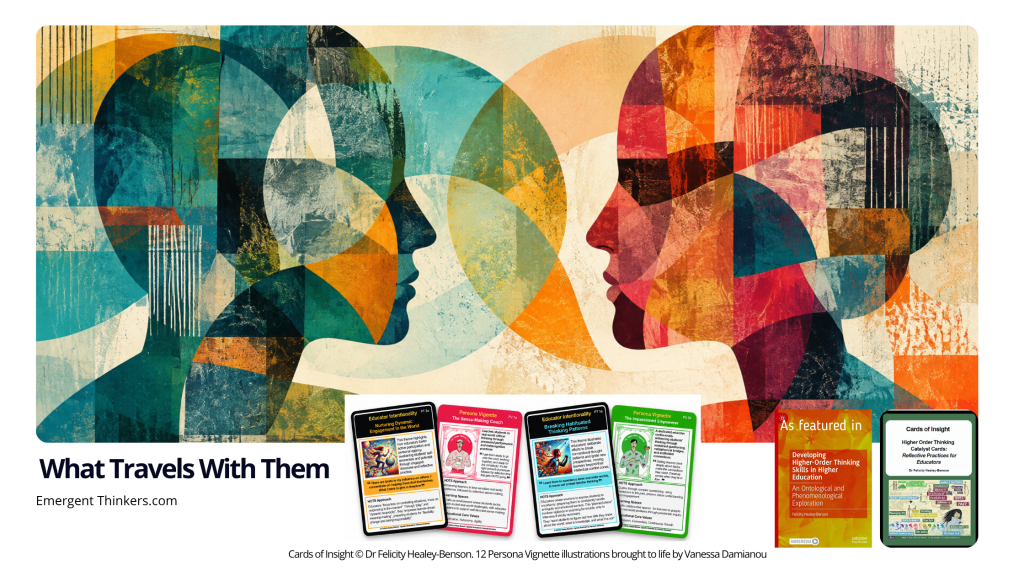
It’s partly what’s taken me increasingly towards reflection and lived experience in my research. My Cards of Insight grew from phenomenological work exploring educators’ experiences of facilitating higher-order thinking. Rather than simply sharing what the research had found, I wanted to return it to practice in a form that allowed people to encounter it, question it and make sense of it through their own experience. The cards have since travelled into very different contexts themselves, including Masters-level practice at the University of Malta. Sometimes a good question does a lot of work.
Staying with the unfinished
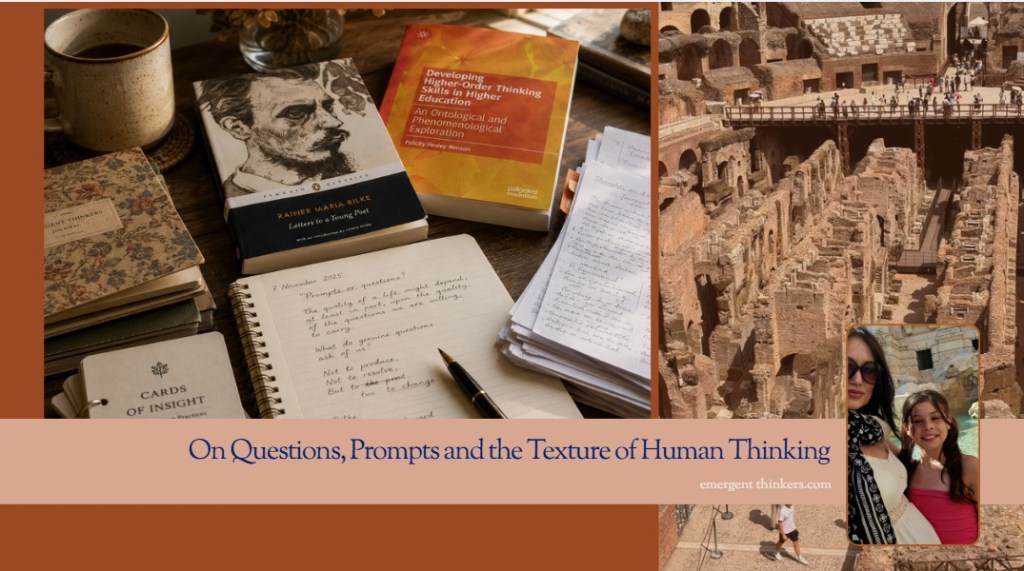
Something else a good question can do too: leave us without an immediate answer. That’s very much harder to ignore as AI enters so many of our educational conversations. I’m fascinated by what these technologies make possible, but phenomenological work has pulled me towards another question as represented in earlier blogs: what happens to the parts of thinking that are slower and harder to see? The hesitation. The struggle to articulate something. The half-formed thought not yet ready to become an output.
Perhaps that’s why the moments in the ISBE programme when somebody disrupted my thinking, rather than resolved it, struck so powerfully. Enterprise education has always asked people to work with uncertainty: opportunities are incomplete, ideas evolve through encounter, and sometimes we act before everything is known. Educators need to create enough safety for learners to experience that uncertainty without immediately removing it for them.
Perhaps one of the capabilities that will travel particularly well into whatever comes next is therefore the ability to stay with the unfinished.
So, to summarise, what truly travels well?
My current list for educators would probably include curiosity, connection and translation, the ability to work across boundaries, the confidence to say I don’t know yet. As well as enough criticality to question the frameworks and technologies we use rather than simply adopt them, and enough reflective space occasionally to notice what our own practice is already teaching us, that these capabilities don’t develop particularly well in isolation. The conditions around professional learning matter too. If we want educators who connect, where are the spaces in which they develop relationships beyond their immediate professional worlds? If we want them to experiment, where can they test things, get them wrong and think again? If we value reflection, where do we protect it from the endless pressure to produce? And if we want educators who can help others navigate uncertainty, where are the professional spaces in which they themselves are allowed not to arrive with the answer?
The ISBE programme gave me new knowledge and perspectives, certainly, and the gift of new people to think with, and generous challenge and reason to look again at work and experiences accumulated over time. Being deliberately placed back in an immersive developmental space has been motivating, that it’s not always about becoming more but the opportunity to see differently, connect something that previously sat apart, test an assumption (or two), return to an old question from a new position, or joyfully notice something valuable that was already there.
So, a slightly belated but very heartfelt thank you to everyone involved, I’ve come away with plenty to take forward…and with more questions.
Perhaps that is no bad thing.
What travels well for educators?…I suspect the answer will keep travelling too.
Felicity




Leave a Reply