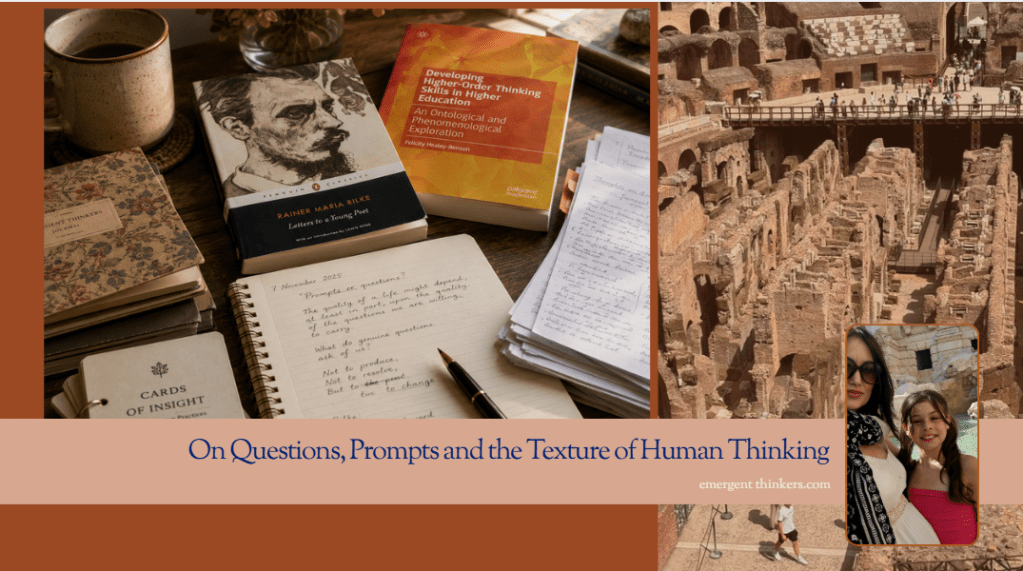
On Questions, Prompts and the Texture of Human Thinking
A short video found me the other day, in the way these things now do, somewhere in the middle of an Instagram or LinkedIn scroll. Someone promising seven questions that would transform my life. I almost kept scrolling. Yet it was not the promise of transformation that caught my attention, but the assumption beneath it: that the quality of a life might depend, at least in part, upon the quality of the questions we are willing to carry. I’ve been turning that over since, connecting it to previous ruminations, although perhaps not quite in the direction the video’s author intended.
One of the privileges of my work is that I get to meet people on the page, sometimes complete strangers through a blind journal review, more often doctoral researchers whose thinking I’ve accompanied for months, years even. Other times they’re experienced professionals trying to find language for practices they have lived for decades without ever quite naming them. Every one of these encounters begins with something unknown between us. I’ve come to regard this unknown as one of education’s greatest gifts, not because it asks to be resolved, but because it asks something of both of us. If I read carefully enough, and if the writer has entrusted something of themselves to the page, there comes a point where I stop reading words and begin encountering their thinking. I cannot help but be fascinated by those moments. It still feels faintly miraculous that one human being can become visible to another through marks on a page.
Those moments have become rarer, or perhaps simply harder to notice. They are rarely found in the finished sentence. More often they appear where someone is still working something out, where language has not quite caught up with thought. Sometimes it is only a hesitation. Those are often the moments I trust most.
I was thinking about this while travelling on the Rome Metro. As we moved through the stations, a female voice accompanied us almost continuously. She announced arriving trains, platform changes, traveller safety, unattended baggage and reminders to mind the closing doors, always clear, calm and impeccably delivered. As the journey continued, I became increasingly aware of the voice itself. It seemed to exist everywhere and nowhere at once, endlessly present yet belonging to no one in particular. There was something about its unmistakable AI cadence that carried me back to the science-fiction films I’d watched as a child, Demolition Man among them, where disembodied voices quietly organised everyday life with seamless efficiency. It was not an unpleasant feeling, but it lingered long after we’d exited.
It took me a few days to work out why. It was not simply that the speech was artificial, but the curious feeling of being addressed without being encountered.
Above ground, Rome had invited me into conversation with centuries of human lives. Earlier that day, wandering through the Forum, I had been struck not by perfection but by accumulation. Worn stone, repaired walls, exposed layers of brick and marble spoke of generations who had built, altered, cared for and inherited what came before them. Nothing had arrived fully formed. Everything seemed to carry the visible traces of becoming.

Down in the Metro, the voice was clear, reassuring and undeniably useful, yet more concerned with movement than with the people moving through it. For a moment I felt less traveller discovering a city and more someone being processed. I was surprised by how unsettled it left me…after all, it was only a station announcement! Yet, set against a day spent wandering among the accumulated traces of human lives, the contrast felt strangely sharp and almost sanitised, as though every sign of the life behind the words had been gently smoothed away. Nothing in the voice hinted at where it had come from, what it had struggled with, what it cared about or what had shaped its way of seeing. What I missed was the texture of a person thinking from somewhere. Perhaps it was the same quality I find myself searching for whenever I read someone else’s work.
More and more, I find myself reading submissions that are beautifully constructed, coherent and confidently concluded, yet sometimes find it difficult to glimpse the movement of thinking that brought them into being. Wondering what surprised the writer along the way, where certainty gave way to uncertainty, or what shifted as the writing unfolded. Those traces are often where I encounter the person rather than simply the finished product. I’ve trusted my instinct that, given enough attention, the writing would eventually give way to the writer. Recently, that has begun to feel less certain. I do not offer this as criticism of AI, but as something I have begun noticing and do not yet fully understand
Lately I’ve been dwelling on the language of prompting. Not because it is replacing questioning, but because it has revealed a distinction I had never consciously articulated before. Asking myself whether prompts and questions belong to rather different ways of engaging with the world. And the more I spend with this, the less certain I am that it is simply a matter of words. A prompt is designed to produce. We refine it, optimise it, engineer it, and then judge it by the quality of what it returns. Its purpose is to move us efficiently towards an outcome. Of course, prompting can itself become exploratory. Yet a genuine question behaves differently. It is rarely efficient, resists optimisation and almost always slows us down. It can unsettle assumptions we did not know we were carrying.
Decades ago, I first read Rainer Maria Rilke’s invitation to live the questions themselves…, to be patient towards all that is unresolved.. and to love the questions as though they were locked rooms. At the time I simply thought it beautiful writing. Now it feels more like wisdom weathered by experience. Some questions are answered. Others ask us to stay with them a little longer, until something begins to shift.
Which brings me back to that short video and its seven transformative questions. I don’t doubt that a well-chosen question can change a life. The questions that have mattered most have never announced themselves as transformative. They’ve arrived quietly, stayed longer than was comfortable, and gradually altered what I noticed before they altered what I knew.
Perhaps there isn’t a neat divide here. Prompting, too, can become deeply thought-provoking. Yet, maybe some questions matter less for what they produce than for what they come to ask of us.
Felicity
Linked Posts





Leave a Reply