What does it feel like to facilitate complex thought?
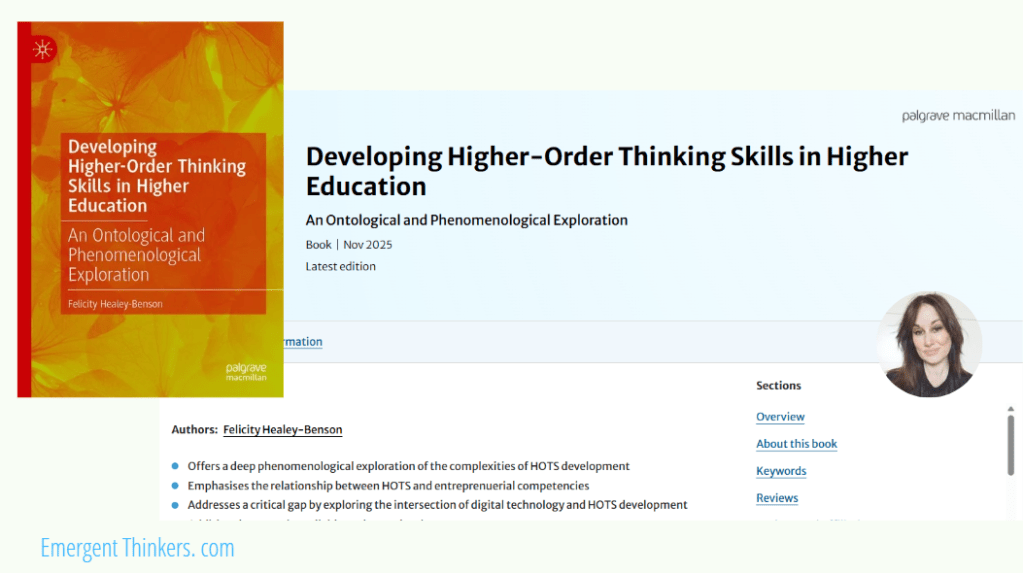
Moments of silence, hesitation, and emergence—often overlooked in mainstream education policy—form the heart of my forthcoming book, Developing Higher-Order Thinking Skills in Higher Education: An Ontological and Phenomenological Exploration. Now in production with Palgrave Macmillan.
This book explores how Higher-Order Thinking Skills (HOTS) are not simply facilitated, but lived—through attuned presence, relational depth, and embodied engagement. Grounded in hermeneutic phenomenology, the study moves beyond taxonomies and outcomes to consider the lived experiences of educators navigating ambiguity, resistance, and emergence in real-time pedagogical spaces.
It introduces two original methodological frameworks:
Persona Vignettes (PV) capturing textured lifeworlds of educators through phenomenological mimesis
Immersive Practitioner Inquiry (IPI) supporting reflective engagement with complexity, uncertainty, and pedagogical presence.
Together, these frameworks offer a way of knowing that resists fixed categories. The book traces how educators draw upon what might be understood as a form of praktognostic knowledge—a nuanced synthesis of embodied insight and interpretive awareness, often enacted through relational sensitivity rather than prescriptive strategy.
A special thank you to Vanessa Damianou, whose illustrations breathe life into the Persona Vignettes, capturing the richness, depth, and complexity of these educator experiences—ensuring these narratives resonate beyond the text itself.
Early review
“This book provides an accessible, bold foray into the important topic of higher-order thinking skills. Drawing on a rich legacy of twentieth-century philosophical thought, a combination of critical analysis, personal experience and clarity of expression results in a pleasurable and valuable read. The book offers depth of insight with practical implications for educators in areas such as AI, professional development and navigating institutional structures. The author aims to create spaces for reflection, dialogue, and deeper attunement to the challenges and possibilities of facilitating thinking in higher education – it hits the mark on all of these counts. A must-read for the educator wanting to engage at a more fundamental level with the meaning of learning in higher education.”
— Associate Professor Dr Andreas Walmsley, Plymouth Marjon University, UK
The digital is not peripheral to this inquiry—it is one of its provocations.
The book also explores how digital technologies and AI are reshaping the very conditions under which thinking can emerge. Drawing on Heidegger’s enframing and Derrida’s pharmakon, it examines how algorithms and learning platforms mediate not just access to knowledge, but the relational, temporal, and embodied fabric of learning itself. Educators facilitating HOTS in such contexts navigate more than technical tools—they dwell within shifting epistemic terrains that both extend and constrain the possibilities for authentic thought.
The book also speaks directly to the lived experiences of educators in Enterprise and Entrepreneurship Education (EEE), where uncertainty, risk, and improvisation are not anomalies but structural conditions. Here, the facilitation of thinking demands ethical sensitivity, attuned presence, and epistemic courage, qualities often overlooked in dominant models of entrepreneurship, but which come to the fore when viewed through a phenomenological lens.
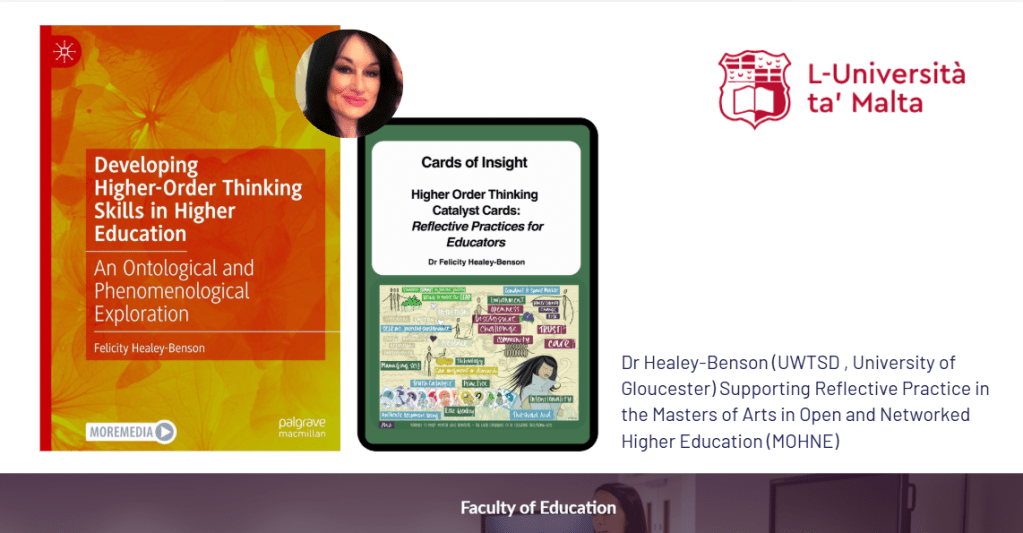
Includes access to my “Cards of Insight”: a downloadable CPD resource of 48 reflective cards designed to provoke professional dialogue and support educators in cultivating attunement, receptivity, and thoughtful presence.
For educators, researchers, and those seeking to reclaim thinking facilitation as a dynamic, situated, and human act.
More soon.
https://link.springer.com/book/9783032061201#about-this-book
#HigherEducation #Phenomenology #CriticalThinking #BookLaunch #ReflectivePractice #AIinEducation #ProfessionalDevelopment #OntologicalPedagogy #HOTS #CardsOfInsight #Pharmakon #ThinkingOtherwise




 Emergent Thinkers™
Leave a reply to Dr Felicity Healey-Benson Cancel reply