
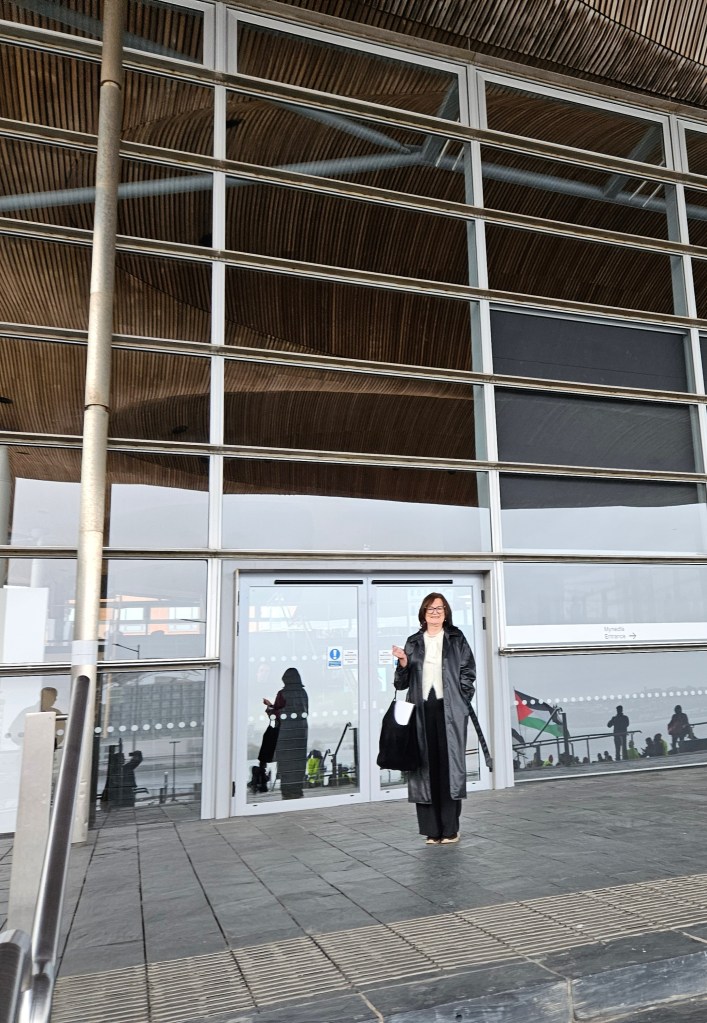
Yesterday, on the second day of GEW2025, I travelled to the Senedd, the Welsh Parliament in Cardiff Bay, with a sense of quiet curiosity, wanting to hear how policymakers might engage with the real, grounded stories of rural women shaping their communities. I brought my mum with me, as I sometimes do when I wear my Emergent Thinkers hat, not as a statement but as part of how I move through the world. She listens with me and helps me make sense of things, and her presence reminded me of the quiet, intergenerational labour that so often supports women’s lives and work without ever being named. So much of women’s entrepreneurial activity, especially in rural Wales, is interwoven with family, care and the steady background labour that rarely appears in any economic account. Who attends and who accompanies tells its own story about the hidden scaffolding that shapes women’s work, revealing how often enterprise is carried by forms of support that sit outside official recognition. It felt right, almost necessary, that this intergenerational thread was present in the room, given that this year’s Global Entrepreneurship Week theme is centred on how entrepreneurs thrive with community.
So, I arrived not only as a listener but as someone whose work sits at the crossroads of enterprise, research and community. In my roles as an entrepreneur, a facilitator of entrepreneurship, a storyteller and a woman navigating these systems myself, I am continually in search of the quieter narratives that reveal how people build and sustain value in ways that fall outside conventional frameworks. I came to the Senedd to understand how these lived stories are received by policymakers, but also to reflect on my own part in surfacing them, connecting them and helping shape a more humane approach to enterprise that recognises care, identity and place as central rather than peripheral.

The session opened with the story of Medina Rhys from Medina Aberystwyth, and her contribution carried a quiet force. She founded Medina in 2015, creating a café and lifestyle space that has grown into a vibrant hub for the town. What started as a small shop has become a place where seasonal food inspired by Mediterranean and Middle Eastern influences sits alongside local creativity, conversation and community warmth. She now owns her building, a rare achievement for a women led independent, and spoke candidly about the realities of running such an enterprise in a landscape that expects small independents to shoulder the responsibilities of many roles without the buffers available to larger firms. She described the strain of rising costs, the relentlessness of being both the face and the backbone of the business and the difference it makes when organisations like Antur Cymru offer grounded, practical guidance that fits the real conditions of rural trade. Her honesty revealed the gap between the richness she brings to Aberystwyth and the pressures placed on independents by systems that still define enterprise narrowly and often overlook the cultural and social value she generates each day.

Jan Martin from the Snail of Happiness in Lampeter set another tone. Her craft shop is grounded in circularity, re use, repair and a formal zero waste policy shaped by her PhD in ecology. Under her stewardship, a small retail space becomes a community anchor that welcomes neurodivergent makers, people living with dementia and anyone seeking calm or connection. Her work strengthens the high street through presence, kinship and care rather than scale. It is a reminder that in rural places enterprise is often social infrastructure woven through daily life. What stayed with me most in her closing reflections was her quiet refusal to accept what she called the masculine view of finance, strengthened by her reference to the book Who Cooked Adam Smith’s Dinner?. Its argument that whole economic systems are upheld by unseen labour resonated deeply with the principles of Harmonious Entrepreneurship that Professor Kirby and I champion, and that guide my own Emergent Thinkers work as a relational broker in education systems, a theme I explored recently at the ISBE conference. The idea that enterprise must recognise interdependence, care and the unseen work that enables economic activity was not abstract theory. It was present in the room, in the stories we heard and in the intergenerational accompaniment shaping my own presence at the event.

The panel added further layers. Eirwen Williams of Mentera Cymru, drawing on her decades of experience in farming, rural development and innovation, spoke of the overlapping roles rural women hold as business owners, workers, carers and community organisers. She emphasised how essential this labour is to rural Wales and how rarely it registers in policy. Professor Sara MacBride Stewart (Cardiff University) built on this with insights from her research on women in farming and diversification, describing the quadruple shift women navigate and the environmental, cultural and wellbeing value they generate. Her argument that our definitions of entrepreneurship must expand to reflect rural realities felt both timely and necessary. Llinos Price from Antur Cymru offered the practitioner’s perspective, highlighting the importance of support that is paced, bilingual and relational, grounded in trust rather than one off interventions.

Listening to them, my attention moved between the micro, the meso and the macro. At the micro level, I was drawn into the texture of each woman’s story. At the meso level, found myself noticing the quiet ecology of support woven by people like Llinos and also, Lynne Rees and Kevin Harrington also in the room, each working in different ways across advisory, development and local strategic roles, yet all providing the steady, day to day support that helps rural enterprises and their communities to flourish. At the macro level, the persistent dominance of a growth centred paradigm became hard to ignore. We are many years into Global Entrepreneurship Week now, and the loudest narrative still celebrates scale and acceleration, while the most meaningful forms of enterprise in rural Wales are small, steady, local and relational. They contribute through belonging rather than expansion.
The handouts shared during the session made this tension even clearer. Rural women often operate micro enterprises, balance multiple caring roles, face digital inequality and practise forms of innovation that remain invisible in formal metrics. Their success is rooted in continuity, dignity and community. The recommendations pointed towards place based investment, flexible finance, long term relational support, improved digital access and broader measures of innovation that recognise creativity, care and environmental responsibility.
Leaving the city and returning to the more dispersed, community driven economy I live and work within, I felt a renewed sense of purpose. The real story of rural entrepreneurship is not only in the enterprises themselves but in the ecosystems of kinship and community that sustain them. The quiet labour of mothers, daughters, farmers, makers and advisers holds an economy together that remains largely unrecognised. If we are serious about building a healthier entrepreneurial landscape for Wales, we must surface these stories and value them on their own terms. This is not simply a matter of celebrating resilience. It is about designing support frameworks that honour the realities of rural women’s work and the wider contributions they make to the wellbeing of their communities.
The theme of Global Entrepreneurship Week this year reminds us that entrepreneurs thrive with community. In rural Wales, this is not a slogan but a lived truth. The challenge now is to ensure that policy reflects it.
Thank you to Bronwen Raine and her wonderful team @ Antur Cymru and to Rt. Hon. Elin Jones, key sponsor of the event.
Dr Felicity Healey-Benson, with Frances Healey
Linked Posts:


 Emergent Thinkers™
Leave a comment