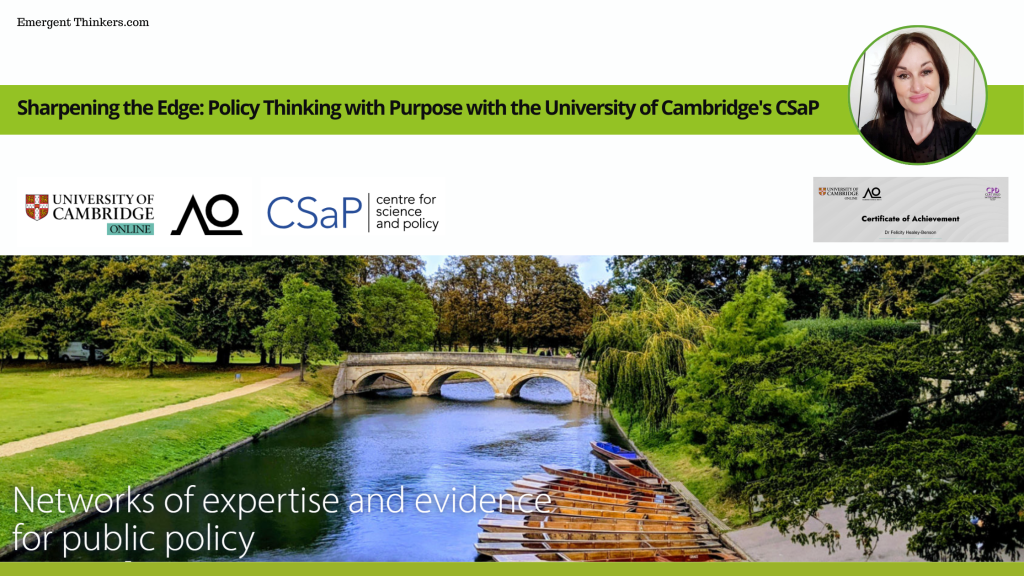
In February I embarked on a deeply rewarding policy development journey with the University of Cambridge’s Centre for Science and Policy (CSaP), and it’s hard to overstate the impact it’s had — not just on my professional toolkit. Spanning several weeks inclusive of over 48 hours of structured learning as part of their advanced certificate programme, this professional development didn’t simply occupy a slot in my diary — it became a space of sustained engagement. Through layered exercises, rich resources, in-depth conversations, and rigorous weekly assignments, the learning journey was intellectually generous and practically demanding, drawing me into a deeper awareness of how policy operates — not only as a process, but as a field shaped by power, evidence, ethics, and lived consequence.
CSaP’s credibility speaks for itself. Positioned at the intersection of science, society, and decision-making, its work tackles some of the most pressing and existential challenges of our time — from AI governance and climate risk to public trust, misinformation, and long-term policy resilience. This course brought that vision into sharp focus, equipping practitioners to think clearly, act responsibly, and contribute meaningfully in a world where decisions carry weight.
It was an honour to be taught by Professor Magda Osman, Head of Research and Analysis at CSaP, a leading voice in decision and behavioural science, whose work spans cognitive psychology, policy impact, and systems reasoning. Her presence brought clarity and challenge in equal measure. Dr Alexandru Marcoci, (Assistant Professor of Global Risk and Resilience at the Centre for the Study of Existential Risk (CSER)) drawing from philosophy, logic, and social reasoning, further offered a compelling frame for thinking through uncertainty and judgement — reminding us that how we reason is as important as what we decide. Their combined input elevated the course from technical training to intellectual cultivation.
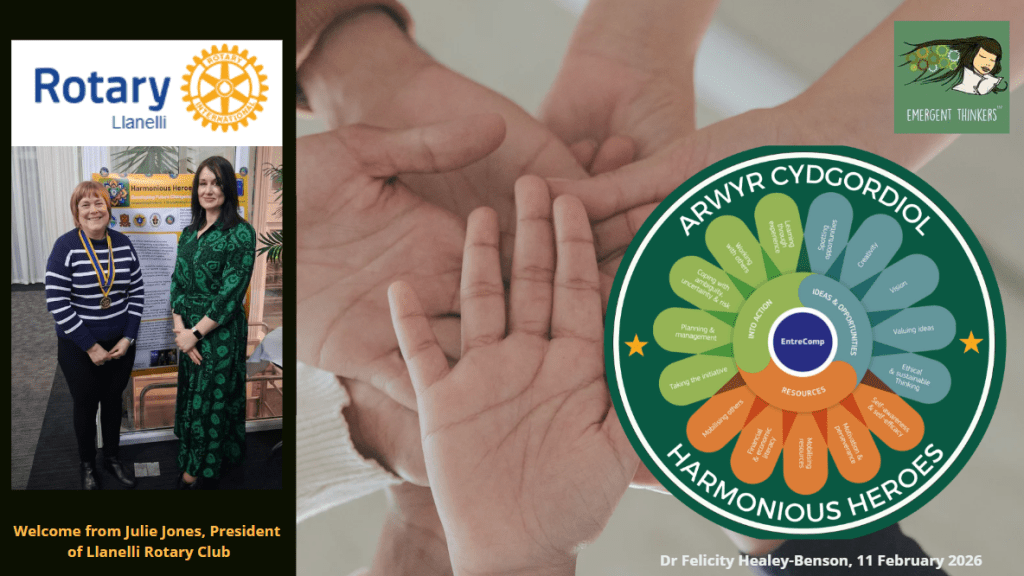
Our weekly topics built progressively — from causal mapping and behavioural insights to stakeholder dynamics and evaluative frameworks — each anchored in both academic rigour and applied relevance. These weren’t abstract tools; they were used in real time to interrogate problems drawn from our own contexts. My final assignment synthesised this journey into a live policy artefact focused on embedding entrepreneurial education across Welsh schools — an area I’m deeply immersed in, and where these insights will now directly influence practice.
Perhaps most valuable, though, was the space this course gave to re-clarify my own position: as someone working at the edge of academia and applied systems change. In a world that often celebrates outputs over outcomes, it’s easy to be defined by academic work alone — papers written, projects scoped, reports submitted. But there’s something far more vital in shaping policy that actually lands. This course sharpened the part of me committed not just to understanding the world, but to contributing to its betterment — with integrity, humility, and sustained impact.
To Magda, Alexandru, the CSaP team, and my brilliant cohort: thank you. You lent not only your expertise, but your energy. The conversations, challenges, and camaraderie we shared throughout the six weeks were as formative as the course content itself. Learning alongside peers from across sectors and systems reminded me how much possibility lies in collective insight — and how powerful it is when great minds meet with openness and purpose.
Felicity
Postnote: CSaP works with a unique network of academics and decision-makers to improve the use of evidence and expertise in public policy. Their approach is based on addressing the questions which policy makers identify, and on building relationships characterised by mutual understanding, respect and trust.

 Emergent Thinkers™
Leave a comment